
Transforming Data into Intelligence
THE PROBLEM
Plants have data.
What they lack is structure.
Modern process plants generate thousands of tags. Pressures, temperatures, flows, levels, compositions, yet most plants struggle to turn this data into trusted information.
Common issues:
- Raw signals stored without engineering context
- Derived values calculated differently across SCADA, Excel, and reports
- KPIs that cannot be traced back to their source signals
- Analytics that silently multiply tags and storage costs
- Engineers who do not trust dashboards enough to act on them
The result is data abundance with decision scarcity.

Introducing
ChemCodex PlantView 3.2
ChemCodex is focussed on data model, not dashboards.
ChemCodex defines what should be calculated, how often, and from which signals — before any visualization or reporting is built.
It organizes plant data into clear, predictable layers.

Distributed Processing Model
Each part of the computational model has defined roles and works independently. This ensures that even if cloud connection or analytical processing breaks, there is no data loss.
RAW SIGNAL PROCESSING
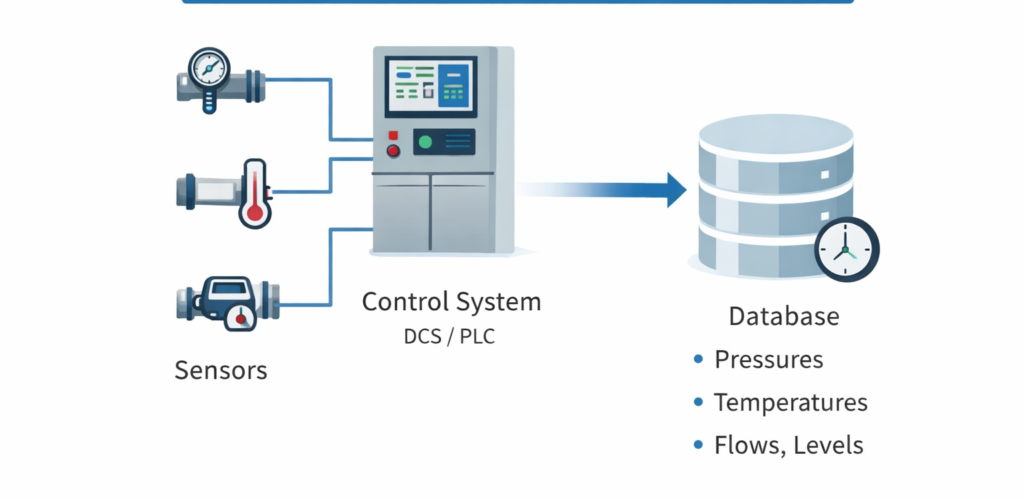
At the foundation of ChemCodex lies the reliable storage of raw plant signals exactly as they are produced in the field. Measurements from pressure, temperature, flow, level, and analytical instruments are transmitted through the plant control systemin to a time-stamped database without reinterpretation or aggregation. Preserving signals in their original engineering context ensures traceability, enables accurate re-calculation of future analytics, and maintains the control system as the authoritative source of operational data.
.
ANALYTICAL MODELLING ENGINE
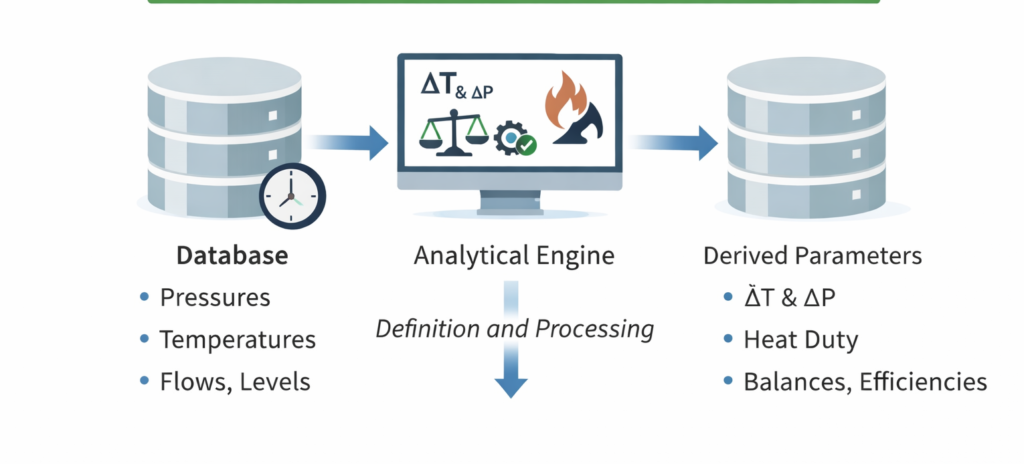
Derived parameters are created by applying defined engineering relationships to the stored raw signals through a controlled analytical engine. Data is organized by physical assets, ensuring better engineering context as compared to pure tags. Data is periodically retrieved from the raw signal database, processed using validated calculation logic such as heat duty estimation, differential values, efficiencies, and material or energy balances, and then written back into structured storage as derived datasets. Because calculation methods, inputs, and execution intervals are explicitly defined, derived parameters remain transparent, auditable, and consistent across all reporting and analytical environments.
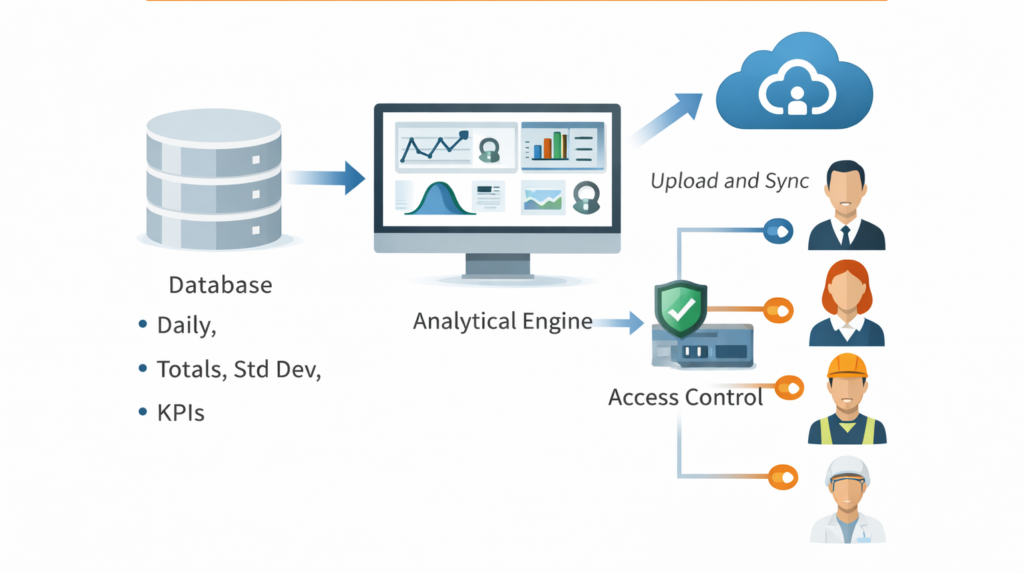
CLOUD CONNECTION AND ACCESS CONTROL
The detailed operational data is converted into meaningful summaries that support plant-level decision making. Dashboards retrieve selected datasets from the database, generate visualization-ready metrics such as daily averages, totals, and stability indicators. The data (raw as well as calculated) can be synchronize to a secure cloud environments for broader access. An integrated access control layer governs which users, roles, or systems can view or retrieve specific data, ensuring that operational visibility is expanded without compromising data security, ownership, or compliance requirements.